NEURAL NETWORKS CONTROLLING SUPERCONDUCTING QUANTUM CIRCUITS

This website provides information about the project entitled "Neural networks controlling superconducting quantum circuits" (acronym ARTEMIS), funded in the 2021 call of the QuantERA program of the European Union. The project ran from April 2022 to March 2026 and gathered four partners. The Quantum Circuit Group at Ecole Normale Supérieure de Lyon (France) coordinated the project and ran the experiments, the Marquardt division at the Max Planck Institute for the Science of Light in Erlangen (Germany) developed the theory and numerical methods, Quantum Machines (Israel) developed the control hardware and Alice & Bob (France) brought its expertise on cat qubits and cloud access to quantum hardware.

ARTEMIS aimed at establishing a neural-network-based approach to quantum control, using reinforcement learning on real-time experimental observations, in order to address two central challenges of quantum computing, namely optimal control and quantum error correction. The project pursued five objectives. (1) A real-time quantum controller embedding a neural network with low feedback latency. (2) Optimization of quantum state preparation by a neural network. (3) Stabilization of a quantum state by measurement-based feedback using a neural network. (4) Quantum error correction of a cat code using a neural network. (5) A cloud service exposing neural-network-based feedback control of a quantum processor. The main outcomes are summarized in the results section.

Press release of the ARTEMIS project announcement (2022).


MAIN RESULTS

Neural network on a quantum controller

Quantum Machines released the OPX1000 controller in 2023 and made it available to the consortium. Its FPGA can host small feedforward networks, but the recurrent networks required for non-Markovian feedback exceed the available capacity. Quantum Machines and NVIDIA therefore developed the DGX Quantum system, which couples the OPX1000 to a Grace–Hopper GPU through a deterministic low-latency interface. The system was delivered to ENS de Lyon in June 2025 as one of its early end-user sites. An adaptive Bayesian T1 tracking experiment measured a non-wait classical overhead of about 11 µs per shot, short compared with the cavity coherence time and with the qubit reset time. The duty cycle of the closed loop is thus limited by the physics rather than by the software stack.

Neural network for state preparation

A neural network was trained in simulation to output directly the four control fields (qubit and cavity I/Q) that prepare any Schrödinger cat state |α⟩ + e|−α⟩ in a 3D microwave cavity dispersively coupled to a transmon qubit. Once trained, the network produces a new pulse sequence for a new (α, φ) in microseconds, about five orders of magnitude faster than an iterative GRAPE optimization for each new state. The experiment at ENS de Lyon reached fidelities close to those obtained by per-state GRAPE optimization (PRX Quantum 6, 010321 (2025)).

Stabilization of a quantum state by measurement-based feedback

The Erlangen team extended the Feedback-GRAPE method to long recurrent control sequences and released the open-source Python package feedback-grape, with GPU acceleration, JIT compilation and automatic differentiation based on JAX. Simulations show that a recurrent network with about 30 000 parameters can stabilize the superposition |2⟩ + |3⟩ of a cavity against decay, using only stroboscopic projective measurements of a dispersively coupled qubit. The same approach applied to the Gottesman–Kitaev–Preskill code improves the logical lifetime by about 100% relative to the standard small-BIG-small protocol (Phys. Rev. Lett. 134, 020601 (2025)). On the experimental side, ENS de Lyon demonstrated single-shot photocounting and photon-number tracking in a cavity whose decay rate is four orders of magnitude smaller than both the dispersive coupling and the qubit emission rate, thanks to a custom notch filter and a pogo-pin galvanic contact (Phys. Rev. Lett. 133, 153602 (2024)). Quantum jumps are observed as photons leave the cavity one at a time. A new reset scheme for long-lived cavities with small static cross-Kerr, the Differential-Drive Reset, was discovered and characterized in the process. The deployment of the trained networks on the actual cavity using the DGX Quantum is ongoing.

Quantum error correction on a cat code

The initial route to the four-photon dissipation needed to stabilize a four-component cat code relied on hard pumping of a nonlinearity derived from the ATS circuit. Experiments showed that at the required pump powers, parasitic effects (qubit ionization, dressed-state populations, pump-induced decoherence) become dominant before the four-photon channel does. ENS de Lyon and Alice & Bob therefore designed the autoparametric cat scheme, which reaches strong multiphoton coupling by structural design rather than by external pumping (Phys. Rev. X 14, 021019 (2024)). The experimental demonstration of four-component cat-code stabilization with this scheme continues beyond the formal end of the project.

Cloud access and technology transfer

The DGX Quantum / OPX1000 product is now commercialized by Quantum Machines. Alice & Bob opened cloud access to its cat-qubit hardware through the Felis Cloud platform, which constitutes the first cat qubit accessible on the cloud. The neural-network-driven control layer on top of it is the subject of ongoing work. The project trained one PhD student to graduation, two postdoctoral researchers and several master students, and included two European deep-tech companies whose roadmaps were shaped by its results.

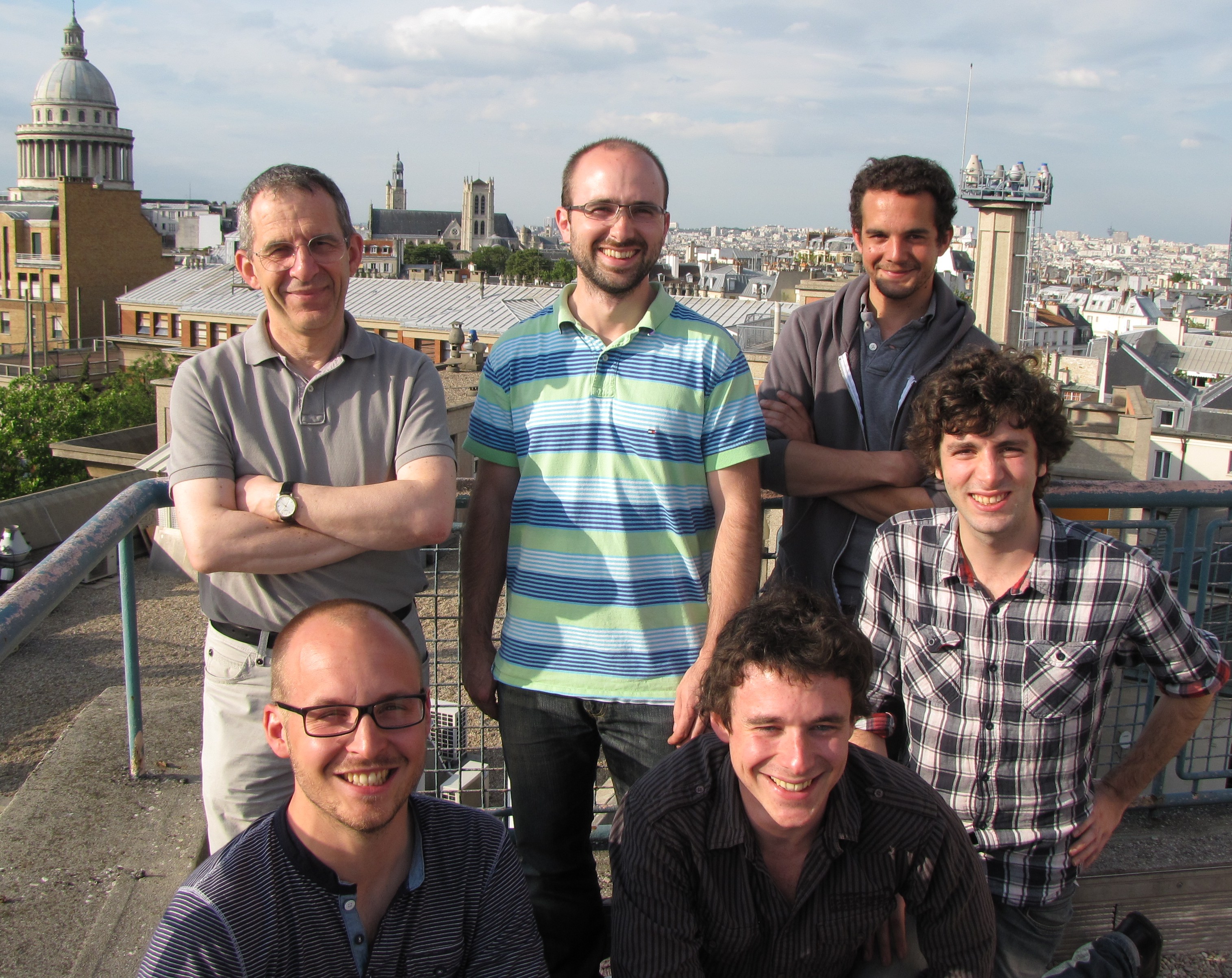
Kick-off meeting, ENS de Lyon, July 2022. A mid-term meeting took place in Garching in August 2023.

PARTNERS

Principal Investigators

Benjamin Huard (coordinator)

Benjamin Huard graduated from the Ecole Normale Supérieure of Paris in 2003 and did his PhD on electronic interactions in metals and mesoscopic superconductivity at CEA Saclay under the guidance of Hugues Pothier. After a post-doc in the Goldhaber-Gordon group at Stanford University, he was hired by CNRS in 2008 and cofounded the Quantum Electronics group at Ecole Normale Supérieure (Paris) with Michel Devoret. Since 2017, he is a professor at Ecole Normale Supérieure de Lyon where he leads the Quantum Circuit Group together with Audrey Bienfait. His research on superconducting circuits covers quantum measurement and feedback, thermodynamics of quantum information, microwave quantum optics, quantum error correction and quantum sensing. He coordinated the ARTEMIS project and led the experimental effort at ENS de Lyon. He is a scientific advisor to Alice & Bob since its creation.


Florian Marquardt

Florian Marquardt is scientific director at the Max Planck Institute for the Science of Light (MPL) in Erlangen, Germany, where he leads the theory division. His team was responsible for the theory and numerical methods of the project. They developed the Feedback-GRAPE framework and the recurrent-network training methodology, released the open-source feedback-grape Python package and trained the networks used for cat-state preparation and for the stabilization of non-classical states.


Yonatan Cohen

Yonatan Cohen is the CTO and a co-founder of Quantum Machines. He has a PhD in physics from the Weizmann Institute, where he worked on carbon nanotube quantum systems in the lab of Prof. Moty Heiblum, and holds an M.Sc. and B.Sc. in physics from the Weizmann Institute and the University of Washington, respectively. Within ARTEMIS, his team developed the controller hardware (OPX1000) and the DGX Quantum system co-developed with NVIDIA, and made them available to the consortium.


Raphaël Lescanne

Raphaël Lescanne is the CTO and co-founder of Alice & Bob. He has a PhD in experimental quantum physics from ENS Paris, working on quantum error correction with superconducting cat qubits. Within ARTEMIS, Alice & Bob co-designed the cat-code experiments, led jointly with ENS de Lyon the development of the autoparametric cat scheme and opened cloud access to its cat-qubit processors through the Felis Cloud platform.


TEAM MEMBERS

Audrey Bienfait

Audrey Bienfait

CNRS Researcher at ENS de Lyon

Audrey completed her Ph.D. in the Quantronics group at CEA Saclay in 2016 on coupling bismuth donor spins to superconducting resonators, then realized a post-doc in the Cleland group at the University of Chicago on coupling remote superconducting qubits with traveling phonons. She joined the Quantum Circuit group in 2019 as a CNRS researcher and took part in all the experiments of the project.

Hector Hutin

Hector Hutin

PhD student at ENS de Lyon, 2021–2024

Hector performed the experiments on single-shot multiplexed photon-number measurement and on neural-network-based preparation of cat states. He defended his PhD thesis in 2024 and is now a post-doc at Inria Paris in the Quantic team.

Pavlo Bilous

Pavlo Bilous

Post-doc at MPL Erlangen since 2023

Pavlo has a Ph.D. in nuclear physics. He led the theoretical development of the neural networks for cat-state preparation and for the stabilization of Fock states with Feedback-GRAPE, and co-develops the feedback-grape package. He visited ENS de Lyon in May 2023.

Nicolas Schmid

Nicolas Schmid

Research engineer at ENS de Lyon, 2025–2026

Nicolas graduated from ETH Zurich. He spent a year in the Quantum Circuit group developing the instruments and protocols for machine learning based control, including the deployment of reinforcement learning on the DGX Quantum system. His master thesis was part of the project.

Arijit Chatterjee

Arijit Chatterjee

Post-doc at ENS de Lyon since 2025

He did his PhD at IISER Pune on quantum information experiments with nuclear magnetic resonance. He now uses machine learning approaches to perform optimal control of bosonic modes and superconducting circuits, pursuing the ARTEMIS line of research within the France 2030 project RobustSuperQ.

Tom Dvir

Tom Dvir

Senior researcher at Quantum Machines

Tom joined the project at Quantum Machines and took part in the neural-network-based preparation of cat states, in particular for the implementation of the control pulses on the OPX controllers.

Satya Bade

Satya Bade

Developer at Quantum Machines

Satya has a Ph.D. in cold atom physics from Pierre and Marie Curie University. Before joining QM he developed quantum simulators on HPC systems at Atos. He worked on pulse-level simulation of quantum systems and their optimization using optimal control.

Gal Winer

Gal Winer

Developer at Quantum Machines

Gal has a PhD in experimental physics, building a cold atom setup. He was involved in the development of neural network libraries for the quantum controller.

Sébastien Jezouin

Sébastien Jezouin

Chief of experiments at Alice & Bob

Sébastien has a Ph.D. in mesoscopic physics under the supervision of Frédéric Pierre and Anne Anthore. He did postdocs in Paris, Sherbrooke and Lyon on superconducting circuits before joining Alice & Bob where he heads the experimental division.

OTHER CONTRIBUTORS

ENS de Lyon. Réouven Assouly (PhD student), Loris Cros, Barath Narayan, Sepideh Abdollahi and Chengzhi Ye (master students).
MPL Erlangen. Tirth Shah and Matteo Puviani (post-docs), Riccardo Porotti (PhD student), Youssef Elbrolosy and Adrian Bories (master students).
Quantum Machines. Lior Ella.
Alice & Bob. Antoine Marquet.

PUBLICATIONS

ARTICLES

Preparing Schrödinger cat states in a microwave cavity using a neural network
H. Hutin, P. Bilous, C. Ye, S. Abdollahi, L. Cros, T. Dvir, T. Shah, Y. Cohen, A. Bienfait, F. Marquardt, B. Huard, PRX Quantum 6, 010321 (2025) (arXiv:2409.05557)

Non-Markovian feedback for optimized quantum error correction
M. Puviani, S. Borah, R. Zen, J. Olle, F. Marquardt, Phys. Rev. Lett. 134, 020601 (2025) (arXiv:2312.07391)

Monitoring the energy of a cavity by observing the emission of a repeatedly excited qubit
H. Hutin, A. Essig, R. Assouly, P. Rouchon, A. Bienfait, B. Huard, Phys. Rev. Lett. 133, 153602 (2024) (arXiv:2402.05046)

Autoparametric resonance extending the bit-flip time of a cat qubit up to 0.3 s
A. Marquet, A. Essig, J. Cohen, N. Cottet, A. Murani, E. Albertinale, S. Dupouy, A. Bienfait, T. Peronnin, S. Jezouin, R. Lescanne, B. Huard, Phys. Rev. X 14, 021019 (2024) (arXiv:2307.06761)

Gradient-ascent pulse engineering with feedback
R. Porotti, V. Peano, F. Marquardt, PRX Quantum 4, 030305 (2023) (arXiv:2203.04271)

Deep reinforcement learning for quantum state preparation with weak nonlinear measurements
R. Porotti, A. Essig, B. Huard, F. Marquardt, Quantum 6, 747 (2022) (arXiv:2107.08816)

Machine learning and quantum devices
F. Marquardt, SciPost Phys. Lect. Notes 29 (2021) (open access PDF)

Multiplexed photon number measurement
A. Essig, Q. Ficheux, T. Peronnin, N. Cottet, R. Lescanne, A. Sarlette, P. Rouchon, Z. Leghtas, B. Huard, Phys. Rev. X 11, 031045 (2021) (arXiv:2001.03217)

GET YOUR HANDS ON THE PROJECT

feedback-grape, the open-source Python package for GRAPE with feedback (documentation and tutorials).

GQF, code for non-Markovian feedback quantum error correction of the GKP code with Feedback-GRAPE.

Felis Cloud, cloud access to a cat qubit (Boson 4 chip) by Alice & Bob.

DGX Quantum, the OPX1000 + Grace–Hopper platform by Quantum Machines and NVIDIA, with its documentation.

Courses and lecture notes on machine learning by Florian Marquardt.

Tools to get you started with QUA programs.

Last update September 2026, based on the final report of the project.